29 January 2018
How embracing technology created a safer environment for colleagues – and a saved nearly half a million pounds in the process.
At the flick of a switch, Network Rail’s London North Eastern and East Midlands’ (LNE & EM) Works Delivery off-track team were able to solve a trio of problems linked to their need to install cable routes at Hebden Bridge, West Yorkshire. Track access, efficiency and safety were top of the agenda.
The complications
The Hebden Bridge work required the up and down lines to be blocked individually and, at times, simultaneously. But a possession on the line can only be granted once every six weeks. Line blockages were used to allow these works to be carried out on mid-week nights. To complicate matters further, a third converging branch line had to be blocked at times, which required extra protection arrangements.
“We wanted to remove the risk to our people. Historically, additional protection involves an individual positioned at a signal, placing a red flag or red light and detonators on the railway. “So we embraced technology to get past these issues.”
Gerald O’Donnell, scheme project manager at Network Rail
The solution
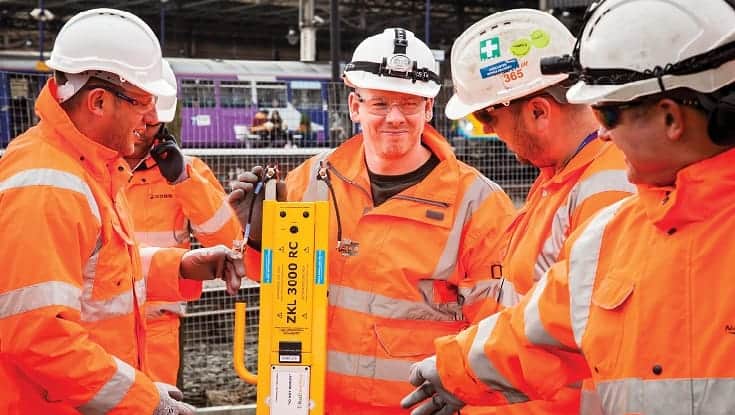
That’s when Network Rail turned to the track circuit operating device (TCOD) – the ZKL 3000 RC – which is pre-installed and remotely-operated. The system can be switched remotely, removing the need to enter the four-foot to place or remove protection once installed.
“With this piece of kit we can press a button to activate a track circuit, which turns a signal to red, meaning a train can’t run through.”
The benefits
For the project, the key benefit was safety to colleagues but there was a significant cost saving, too. There were three reasons to use the ZKL 3000 RC: safety, capacity and efficiency. The technology means that track workers no longer have to spend time in the four-foot to install safety measures. The kit can be deployed during the day at the signaller’s discretion. There’s more efficiency in the process; multiple calls to the signaller, the person putting the protection in place and the team carrying out the work are no longer necessary.
“The Office of Rail and Road (ORR) came to see us work with the kit and they couldn’t understand why it’s not business as usual everywhere, especially when you look at the savings and safety benefits. It helped us gain, on average, 60 minutes a night, which meant seven hours a week on the project. We reduced the number of shifts required to carry out the work and the people-hours.”
Read more:
Link to the full article in Network Rail’s magazine Network.